Friday, November 13, 2009

Parcour de Wild 2009

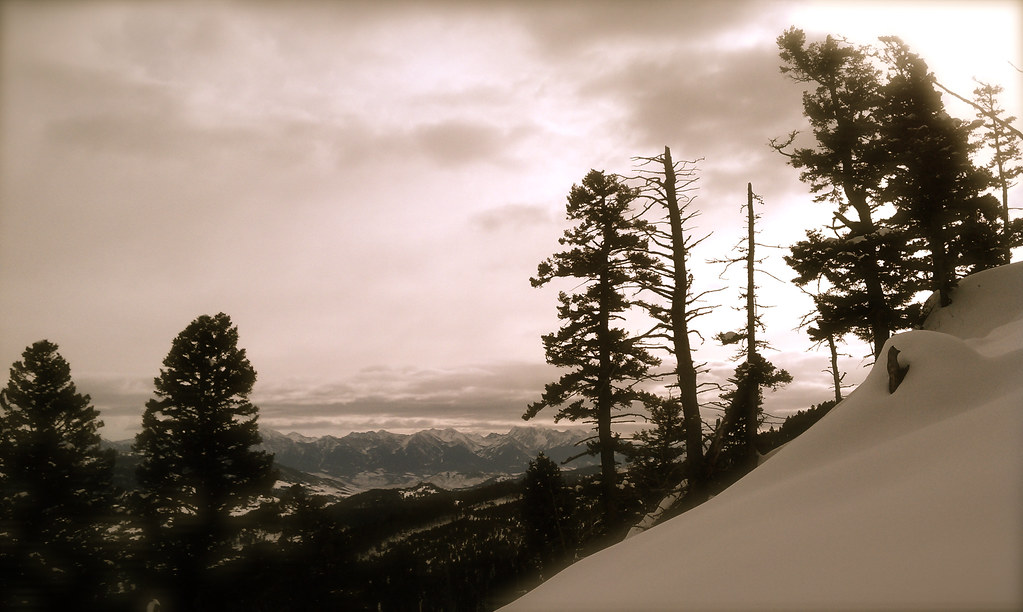
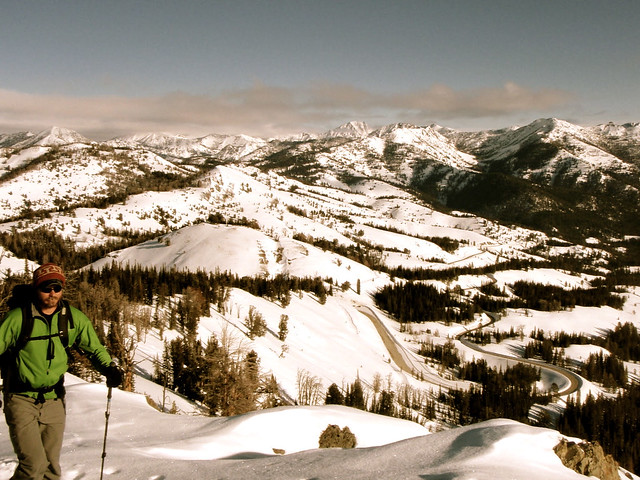
Continental Divide TrailOn October 11th, 2009 Matt Lutz and Sam Haraldson drove to the Continental Divide along the desolate Montana Hwy 200.  Arriving at the 5,610 ft trailhead and finding just shy of a meter of snow paired with temperatures around 10 deg F the duo put on their hardmen game face, snowshoes, backpacks, and began climbing from Roger's Pass to the Crown of the Continent - the Continental Divide National Scenic Trail.

SunriseFor the previous months Matt and Sam had been planning a route across parts of the Helena National Forest comprised primarily of the Bob Marshall with the expectation of traveling between 130 and 165 miles as part of the loosely-organized wilderness adventure race Parcour de Wild.  As the date for the trip grew nearer the snow began to fall in NW Montana and Sam and Matt's chances of making 150 miles along the Continental Divide grew slim.  Much planning had gone into the route and little time was left to create a Plan B so when Matt arrived at Sam's house in Bozeman after driving from Minnesota the two stuck with their plan. 

MattEven with the first steps from the highway, over the five foot embankment of plowed snow, up the switchbacks to the top of the first ridgeline Sam was doubtful of the teams ability to complete their route.  Being the perservering type he kept his mouth shut and mentally determined his mindset would be that of forward-progress with no particular end-goal intent.  Sam and Matt discussed their plans in ongoing dialog as they walked for the first and second day.  Sometime during the second day after having only made less than a dozen miles they knew the focus of the trip should change from fast and light adventure race mode to an enjoyable winter camping trip. 

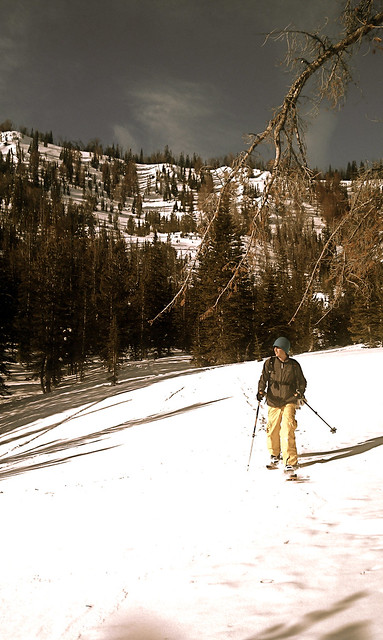
MattAfter a decision to hike out-and-back rather than push on toward the finish was determined - a decision which did not negatively affect either hiker - the lightness of step that is found in any fun backcountry excursion continued with each snowshoe placed into the glistening white powder.  Matt and Sam hiked until a pre-determined time, had some lunch, melted some water, and then began back-tracking their steps toward the trailhead and waiting automobile. 

Golite Shangri-La 2Although we set out to do a light and fast adventure race both Matt and Sam decided to themselves and openly to each other that this sort of pursuit would be better suited to them in summer months.  Matt is an ultramarthon runner with multiple races under his belt and Sam is a thru-hiker with a couple long trails to his name.  They both enjoy hikes in the 20 to 30 mile range and if this race had taken place one or two weeks earlier the duo felt they would have been in contention. 

CDT cairnOnly two other racers opted to participate in the event and they were successful, completing their intended route with smashing success.  Dave Chenault and Kevin Sawchuk's race report can be viewed with a subscription to BackpackingLight.com at Parcour de Wild 2009. It was rewarding to both Matt and Sam to hear the other two had participated and completed the route for it added a legitimacy to the event.  The four men who were out in the cold that snowy week in October may not have all finished but they could be certain they had planned, prepared, and set-out to do it.  There were eight other individuals who originally intended to race the Parcour de Wild that ultimately did not.  There is something to be said for at least giving it a go. 

Video Trip Report:

Trip Photos

The full set of photos for this trip can be seen at:

http://www.flickr.com/photos/walloftvs/sets/72157622795840046/

Tuesday, June 30, 2009

Moving by Bicycle

In June of 2009 I made up my mind to move from one apartment to the other. I also made up my mind to make this move using only bicycles and bicycle trailers. After making up my mind to do this I did some research and found some great testimony to this from other individuals and groups having done this on the Internet.

Two days ago, after I'd decided to move I found out about a contest that Madsen Cycles was putting on. If you're interested in helping me win, click this link to their site and check out their cool bicycles (it'll open in a new tab/window).


I started off on a Sunday afternoon by loading a few plastic tubs into the "kid trailer" I pull with my Schwinn Tempo road bike.


Schwinn Tempo and Converted Kid Trailer.

After the first load with the Schwinn I sent a text message to my buddy Captain E to see if I could borrow his Madsen Cargo Bike. I did two more loads with my Schwinn/trailer combo and then heard back from Captain E so I cruised down to pick up the Madsen.

Upon retrieving the Madsen and Captain E's homemade bike trailer I could tell that this game was ON! I rode it home and began to load it up with my stuff. I've moved a lot in my day and I have numerous plastic tubs to hold just about everything. This made loading the flatbed trailer a breeze.


The Madsen loaded up.

The consecutive loads went off without a hitch as well. I was able to stack tubs on the trailer and bulky, odd-shaped items into the Madsen's ample bucket.


The snowboards depict a common site in any Bozeman move.


Note the fly rods sticking out the top of the traffic cone.


Having things packed well from the get-go is important.


Furniture, skis, you name it!

The last load I had been contemplating since the start. When I set off to make this move using only a bicycle I assumed that the last load I made would be in my automobile. I justified that I would have to move my car from one location to the next and that it made sense to load it up with stuff. Although, as I proceeded further and further with the move I became more and more stubborn to move everything with cycles. The last item left was my boxspring, mattress, and bed frame. I solicited the help of fellow members of the Bozeman bicycling community whom I know are up for general jackassery such as this. Responses from SingleTrackM1nd and tjdzor came swiftly and with great enthusiasm.

The three of us sat in the sunshine pondering the massive load, first making attempts to put the mattresses on SingleTrackM1nd's Xtracycle. The weight was no problem for the Xtracycle but the size was. It became clear, quickly that the Madsen would have to be used as the width of the bucket was idea for balancing the width of the load of the bed.

After placing the load onto the bucket one test run was made unsuccessfully but I felt confident in my abilities so we re-secured the load and set off down the street. SingleTrackM1nd and tjdzor road ahead blatantly stopping traffic at the two major intersections, laughing, shouting, and capturing video along the way. The load was precarious and it required great concentration but in the end there was SUCCESS! A whimsical video was captured by tjdzor. Check it out:


The Madsen made it all the way from point A to point B, albeit with general un-stability requiring some careful maneuvering. But, it DID make it. No egg on my face.

Monday, June 22, 2009

Packrafting- East Gallatin River, Bozeman, MT

A few hours were available at the Backpacking Light offices so the packrafts were grabbed, coffee was consumed, the river was reached and the boats were unleashed. 

The route:


The video:


The photos:

Takashi loads into an Alpacka RaftTakashi taking his first strokesTakashi and Ryan discussing the riverThe Bridger Mountain RangeThe Bridger Mountain Range

Tuesday, June 16, 2009

Backpacking Light - Wilderness Trekking School - WS1-LWB

This past weekend, June 12th - 14th, our six member team consisting of four students and two instructors set out into the Gallatin Mountain Range of SW Montana to learn the principles of Lightweight Backpacking during Backpacking Light's Wilderness Trekking School course, "Wilderness Skills I, Lightweight Backpacking".

BPL's course was taught by Mike Clelland! and Sam Haraldson. The four students were BPL members, Bruce, Gregg, Dave, and June. Level of experience ranged from 30 years backpacking to some without much experience, but with lots of ambition.

The course focused on teaching more than trekking and involved one day in the classroom followed by two days of hiking and outdoor learning sessions. Over the course of the two half-day and one full-day of hiking we only covered about a dozen miles but interspersed that with lessons in ultralight backpacking gear, bear bag hanging, proper shelter pitching, hygiene, hiking tempo, foot care, water treatment, cooking gear, and much more.

Clelland and Haraldson, as well as a half-dozen other guide/educators will be offering more courses throughout the summer if you find this interesting check out BPL's offerings at:

backpackinglight.com/school

Photos from the trip are as follows:

Post-trip gear and food weighingSam - self portraitMike Clelland! and Sam HaraldsonRequisite ultralight backpacking group photo
Bridger Mountain Range from Chestnut RidgePCT method of bear baggingPCT method of bear baggingGregg sets up his Backpacking Light spin tarp
Sam - self portrait with StickPicSam - self portrait eating spring beautiesGreggGregg and Mike
BruceJune and DaveOrchidSam and Bruce
Lion's Ridge shuttle busJune writes down her initial gear weightsOur group food ready for weighingMike makes coffee

The route we chose:
Widget powered by EveryTrail: GPS Community

Wednesday, May 13, 2009

MYOG: Bubble Wrap and Duct Tape Camera Case


I have written an article for Backpacking Light.  It is a make-your-own-gear article and it's free to the general public for viewing.  Take a look at:

MYOG: Bubble Wrap and Duct Tape Camera Case

Tuesday, April 14, 2009

Researching, Planning, and Remembering Trips - Part One

Fulfillment
In the past few years I've found the best way to maximize the amount of enjoyment I gain from a backpacking trip is to spend time before the trip researching, mapping, and planning. Then, upon my return home I opt to spend time cataloging, memorializing, and sharing the trip through my Web site, a photo-sharing site, and a trip-sharing site.

This is the first of a two-part blog series in which I will discuss my pre and post trip processes. If you find all of this silly and would prefer to read only about activities during a backpacking trip, feel free to explore this site as I have dozens of trips cataloged herein.

Part One: Planning and Research
My research and trip planning involves a multi-pronged approach, but the most time is spent poring over maps, both paper and digital. I generally start the process using a large-scale area map to hone into the particular mountain range, drainage, or zone that I'd like to explore. After that has been determined I scale down the area of precision using my computer.

I primarily use the Google Earth software with a free USGS topographic map overlay installed. Once I've zoomed in on the area I determined to explore I use a series of Google Earths tools to map out my route and points of interest. I first make the USGS topo layer visible so that I can see any trails or other man-made features that are present in the area I want to explore. I next trace my chosen route into a new Earth layer using the "Add Path" tool. I turn the topo layer on and off to see how my route looks on the satellite image as well as on the map image. Next I use the Google Earth "Add Placemark" tool to mark the location of trailheads, possible campsites, or other locations of note along my route.

Within the Google Earth software I organize my routes within a folder structure. I have a folder for each of the states in which I've done trips. Within the folder for the particular state are sub-folders that are based on areas, whether that be a mountain range, a long trail, or a park. For instance in my folder entitled Montana there are sub-folders for the Bridger Mountains, Yellowstone, and Continental Divide Trail. Within the sub-folder there is yet again another series of folders - one for each trip. If I opt to hike a route twice but do it slightly different I may make a new folder that has information specific to it.

Google Earth is a great way to look at a trail from various points of view. You can see your route from above as if looking at a map or you can see it from a birds eye view at an angle from the sky, and you can even maneuver yourself along the trail at ground level to get a feel for how the terrain feels before you get there.

Part One: Data and Analytics
I'm an analytical person as well as a spatial person and maps aren't enough information in my thirst for data. For this reason I like to extrapolate specific mileage and elevation data from the mapped information. This is where a very useful Web site, GPSvisualizer.com comes in handy. There are a multitude of functions that this online software can perform but I find a handful of them most useful.

The first step in turning the pretty little map I've created into rows and columns of data is to export a .kml file of my route from Google Earth. This is done by selecting the trip folder, right-clicking on it, and selecting "Save Place As". This will save all your path and placemark information in the .kml file format. The .kml file can then be turned into a number of other file formats using GPSVisualizer.


Using the "Convert a File" link at GPSVisualizer I am able to create a spreadsheet that contains mileage data. This information can then be entered into the form at the "Look up Elevation" link. A third step allows me to create a section profile of the entire route. A section profile is graphical analysis of the route depicting mileage and elevation information.

Part One: Conclusion
To summarize, in this post I've discussed the use of paper maps, Google Earth software, and the GPSVisualizer.com Web site to research and view potential trip routes. I have a number of routes that I've prepared, but not yet hiked.  These provide a fun way to dream of places to go in the backcountry.

Stay tuned for the next installment in which I impart wisdom of how I go about sharing a trip with friends, family, and other onlookers whom may be interested in that trip themselves or just interested in what I'm doing after I've returned home. Some of the tools I use for that are my Web site, Flickr.com, and EveryTrail.com. But that's enough of a sneak peek - - until next time, happy hiking.

Friday, April 10, 2009

Summit Cheeseburger - Drinking Horse Mtn; Bozeman, MT

Drinking Horse Mountain - View from the Car

Drinking Horse Mountain - View from the road

Drinking Horse Mountain - 93 Subaru Legacy at trailhead

Drinking Horse Mountain - Info Kiosk

Drinking Horse Mountain - Sam Self Portrait atop Summit

Drinking Horse Mountain - A rudimentary shelter

Drinking Horse Mountain - View of Bozeman

First I drove from my house in Bozeman, Montana to the Drinking Horse Mountain trailhead. It is located on Bridger Canyon road.

On the way to the trailhead I took some pictures of Drinking Horse Mountain. It is about 629 feet tall.

I parked my 1993 Subaru Legacy in the roadside parking lot. As you can see, my car is almost as tall as the mountain.

Like any good city trail there is a nice informational kiosk with a map and some little handouts. I stopped and took a picture for you to see.

Suddenly I was at the top of Drinking Horse Mountain consuming a double cheeseburger. I kept the cheeseburger wrapped in a knitted hat inside a stuff sack while I hiked. It was warm and delicious.

Near the summit of Drinking Horse Mountain someone has constructed a nifty fort out of dead tree branches. It was neat.

The proper summit of Drinking Horse Mountain doesn't provide too amazing of views, but slightly to the North a quality view of Bozeman is there for all to see.

I made a thirty-five second video of the hike to the summit.